

Bush fire risk in the Mid Lachlan Valley
Fire agencies, land managers and other stakeholders have been working to identify ways of reducing the impact of fires on our area – protecting lives, homes, businesses, agriculture, the environment and other assets that are important to the Mid Lachlan Valley.
The local Bush Fire Management Committee has developed a Bush Fire Risk Management Plan, which identifies the risks and the plans to protect them.
The plan identifies the risk to communities and the assets we all value. Using feedback from fire agencies, land managers and other stakeholders, the plan identifies ways of reducing the impact of fires across our area.
By planning together, we will help shape the Bush Fire Risk Management Plan for our area for the next five years.
How the Mid Lachlan Valley Bush Fire Risk Management Committee have assessed the risk
Fire is a part of living in the Mid Lachlan Valley. It has been a part of this landscape for millions of years.
As our population and region changes, the risk of fires impacting on our community has changed.
To understand the bush fire risk in the Mid Lachlan Valley, and help inform the best ways of managing and reducing the risk, we’ve looked at what’s important to local communities – including where people live, as well as environmental, economic and cultural assets.
We look at the assets across the landscape, and using computer modelling, we have tested scenarios for possible fire conditions to understand the impact on the community.

| Residential: The residential risk map shows the modelled risk to homes and properties from bush fires. Each coloured square on the map represents the risk to a home or a group of homes. The map displays the comparative risk across the local Bush Fire Management Committee area. If your home is in the lowest risk category it can still be damaged in a bush fire, it is just less likely to be damaged compared to other areas. |
 | Economic: The economic risk map shows the modelled risk to economic assets from bush fires. The risk is calculated based on the economic loss of the modelled damage assessment and how long it is expected that the asset will return to the pre-fire condition. These are important considerations because if they are destroyed during a fire, they can have long lasting impacts on employment and population in the area. |
 | Environmental: This map shows the environmental assets that have been modelled as being at highest risk from bush fire in the area. This includes areas at risk because they contain threatened species vulnerable to fire, vegetation types sensitive to fire e.g. rainforests or land managed for conservation or environmental outcomes that does not include fire. |
 | Cultural Predicted Aboriginal Assets: This map shows the predicted Aboriginal cultural assets that have been modelled as being at the highest risk from bush fire in the area. |
 | Historic Heritage Sites: This map shows the modelled risk to historic heritage assets from bush fires. The risk is based on the significance of sites, the vulnerability of sites and the likelihood that sites will be exposed to a fire that will cause damage. |
 | Fuel Management Register and Focus Areas: This map shows the Fuel Management Register – a list of hazard reduction activities identified as strategic treatments in the risk plan. The Fuel Management treatments include prescribed burns, BFMC managed Asset Protection Zones and the development or maintenance of Fire Breaks. This map also displays the areas identified by the Bush Fire Management Committee as Focus Areas. |
Managing the risk in the Mid Lachlan Valley
We have considered the risk to people and assets across the area to determine the most appropriate and effective way of managing that risk.
There are some measures which apply broadly – such as vegetation management, development controls, bush fire education, and fire suppression activities. These activities reduce the bush fire risk to assets and communities throughout the area.
Where an unacceptable risk exists for a particular area or assets, additional targeted treatment strategies are planned during the next five-year period. These treatment options include:
- Fuel management – the reduction or modification of bush fire fuel with the intent of slowing the spread of bush fire and aiding firefighting operations. This may be identified as;
- Asset protection zones – these are typically close to homes, and provide a separation from the bushland to reduce the impact of fires, and give firefighters a safe place to work if protecting homes in a fire;
- Ignition management zones – areas in the landscape maintained at a reduced fuel level to minimise the propagation of ignitions and limit the rapid escalation of fires;
- Strategic fire advantage zones – these are areas across the broad landscape which, when treated, can help slow the spread of a fire across the landscape;
- Firebreaks – areas designed and managed to provide fuel reduced areas from which a fire can be suppressed.
- Ignition prevention – activities to prevent or reduce bush fire ignitions whether they be accidental or deliberate. This includes community preparedness programs, fuel management and specific actions in the Ignition Prevention Plan.
- Community preparedness – activities such as working with residents to improve their level of planning and preparation for a fire, to increase the survivability of their home and families in the event of a fire.
- Response – specific response requirements for a particular area or value in addition to standard procedures. This may include specific actions in the BFMC Plan of Operations or Fire Access and Fire Trail plan.
The Mid Lachlan Valley Bush Fire Management Committee is made up of a range of stakeholders from the area including emergency services, land management agencies, local government, local Aboriginal land services and local community groups. This ensures key community stakeholders have a say on bush fire management activities for the benefit of their communities.
The Mid Lachlan Valley Bush Fire Management Committee is made up of the following representatives:
- NSW Rural Fire Service
- NSW Department of Planning, Housing and Infrastructure (Crown Lands)
- Essential Energy
- NSW Farmers' Association
- Fire and Rescue NSW
- Forestry Corporation of NSW
- Forbes Shire Council
- Parkes Shire Council
- Lachlan Shire Council
- Weddin Shire Council
- Local Aboriginal Land Councils
- NSW National Parks and Wildlife Service
- NSW Police Force
- Transport for NSW
- Australian Rail Track Corporation
- UGL Regional Linx
- NSW Local Land Services
- Forbes Aboriginal Community Working Party
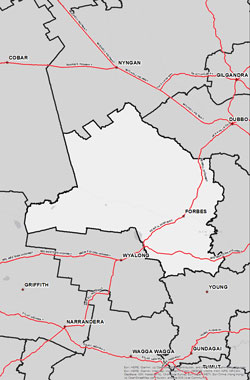
The Mid Lachlan Valley Bush Fire Management Committee area spans 2,899,977 hectares. The area covers the Local Government Areas (LGAs) of Forbes, Parkes, Lachlan and Weddin and features National Parks covering an area of 274,511ha (9.46% of the BFMC area) and State Forests covering an area of 195,109ha (6.2% of the BFMC area).
The Mid Lachlan Valley area has approximately 22% bushland and 77% grassland with the balance being the built environment or water bodies. A bush or grass fire can happen at any time of the year, but the risk is higher during the warmer months, when bush, grass or scrub is drier.
-
 According to the Australian Bureau of Statistics 2021 Census Community Profile there are 14,626 residential dwellings in the Mid Lachlan Valley BFMC area with an approximate population of 29,993.
 -
 According to the ABS data on the counts of Australian businesses, there were 2,369 businesses in the Mid Lachlan Valley BFMC. The top three included construction, Rental, Hiring and Real Estate Services and agriculture, fisheries and forestry accounting for approximately 70% of businesses in the Mid Lachlan Valley BFMC area.
 -
 The last major bush fire happened in the 2014/15 bush fire season with 2,220 hectares burned.
 -
 There are several valuable community assets across the area along with a number of culturally significant sites and environmentally important sites.

For more information contact your local NSW RFS Fire Control Centre

