

Why we need a plan
Bush Fire Risk Management Plans are an effective instrument for managing risk to human activity and valued community and environmental assets. They are a key component in a multifaceted bush fire management approach for NSW.
Developed using robust data and sophisticated technology and modelling, the plans determine risk factors and develop solutions that best mitigate them.
Feedback from the exhibition of a draft plan for Northern Beaches is currently being assessed. Public feedback will be taken into consideration as the plan is finalised by the Northern Beaches Bush Fire Management Committee before being sent to the Bush Fire Coordinating Committee for review.
Current Bush Fire Risk Management Plan for Northern Beaches
The Bush Fire Risk Management Plan for Northern Beaches was prepared under two previous Bush Fire Management Committee areas.
Current Bush Fire Risk Management Plans (BFRMP) for the Northern Beaches BFMC are the Warringah Pittwater and part of Manly-Mosman-North Sydney.
The Warringah Pittwater BFRMP was approved on 22 Oct 2010 and the Manly-Mosman-North Sydney BFRMP was approved on 22 September 2010.
These BFRMPs identify the bush fire risks in the Northern Beaches BFMC area and set out the types of work scheduled to deal with the risk of bush fires.
BFRMPs are updated within every five-year period, however, the treatments and works set out in the plans are subject to change on a yearly basis due to fire activity, weather and new risk factors. This plan may not have been updated with the latest treatment and works plans/information.
Northern Beaches BFMC is made up of a range of stakeholders from the area including emergency services, land management agencies, local government and local Aboriginal land councils, and local community groups. This ensures key agency stakeholders have a say on bush fire management activities for the benefit of their communities.
Northern Beaches BFMC is made up of the following representatives:
- NSW Rural Fire Service
- NSW Department of Industry (Crown Lands)
- Energy Australia
- Transgrid
- Fire and Rescue NSW
- Northern Beaches Council
- Metropolitan Local Aboriginal Land Council
- Nature Conservation Council of NSW
- NSW National Parks and Wildlife Service
- NSW Police Force
- Transport for NSW
- Department of Planning and Environment (Office of Strategic Lands)
- Sydney Water
- Sydney Harbour Trust
- Greater Sydney Local Land Services
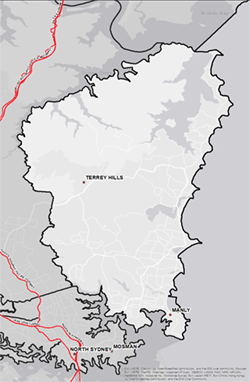
The Northern Beaches Bush Fire Management Committee (BFMC) area spans 27,670 hectares (ha). The area covers the Local Government Area (LGA) of Northern Beaches and features National Parks covering an area of 11,344ha (41% of BFMC area).
The Northern Beaches BFMC area has approximately 63.6% bushland and 5.8% grassland with the balance being the built environment or water bodies. A bush or grass fire can happen at any time of the year, but the risk is higher during the warmer months, when bush, grass or scrub is drier.
-
 According to the Australian Bureau of Statistics 2021 Census Community Profile there are 102,024 residential dwellings in Northern Beaches BFMC area with an approximate population of 250,828.
 -
 According to the ABS data on the counts of Australian businesses, there were 32,340 businesses in the Northern Beaches BFMC. The top three industries in the BFMC are education and training, construction and information media and telecommunications. These account for approximately 50% of businesses in this BFMC.
 -
 The last major bush fire happened in the 2012/13 bush fire season with 1,517 hectares burnt.
 -
 There are several valuable community assets across the area along with a number of culturally significant sites and environmentally important sites.

For more information contact your local NSW RFS Fire Control Centre

